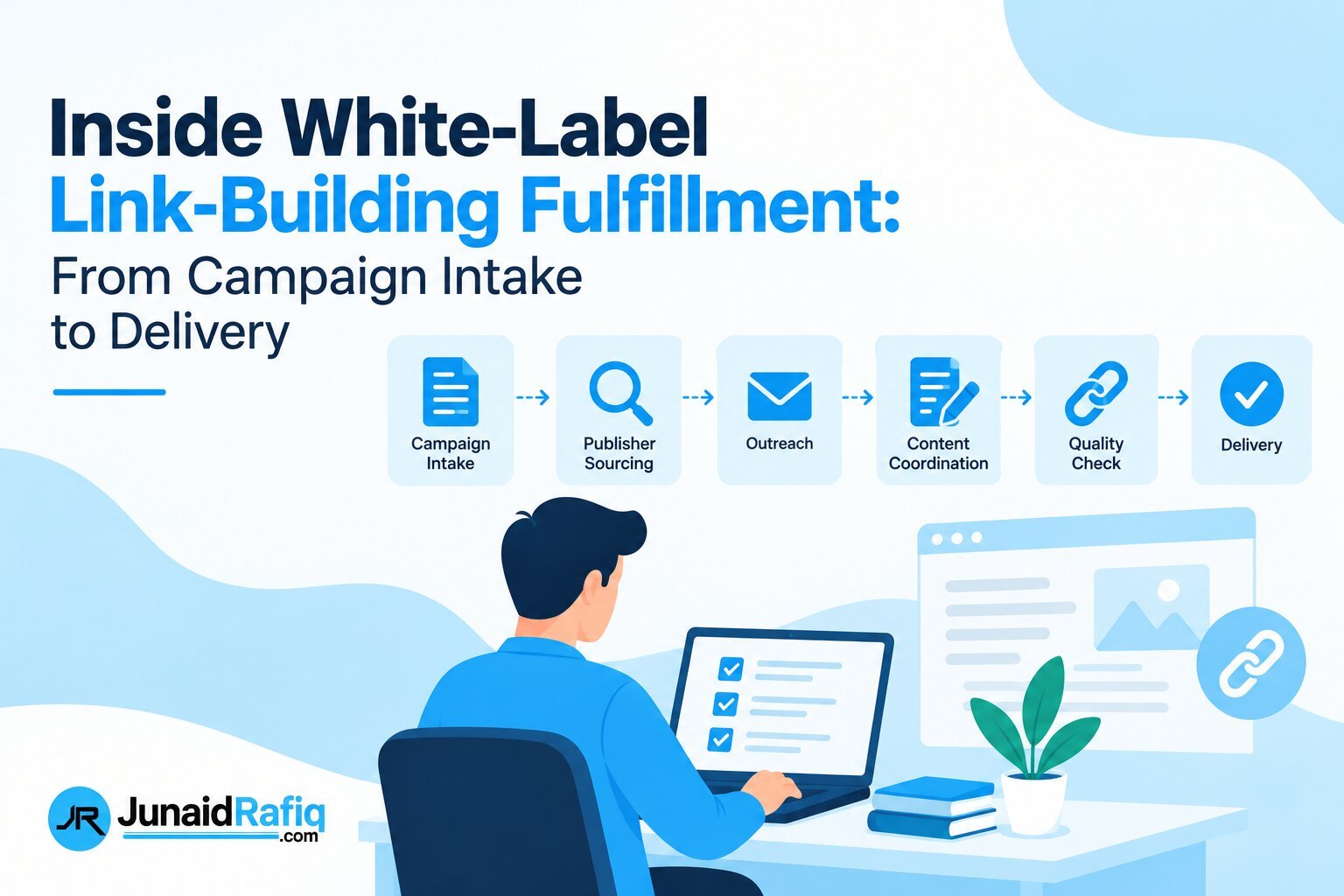
When an SEO agency sells 35 backlinks to a client, the client usually sees a simple result: 35 published live links.
Behind those links, however, there can be a much larger operation.
Someone has to organize the campaign, check the requirements, assign the work, manage website opportunities, contact publishers, coordinate content, track responses, handle delays, check completed placements, and keep records of everything.
That operational work is white-label link-building fulfillment.
Fulfillment is the part of the service that happens behind the agency’s client-facing relationship. The agency may sell the campaign, manage the client, and set the strategy, while the fulfillment team manages the production and delivery work.
This distinction matters because a fulfillment operation is not simply a list of websites or a person sending outreach emails.
It is a delivery system.
A good system needs clear campaign information, organized website inventory, defined quality checks, communication between teams, tracking, quality control, and a way to deal with problems when things do not go according to plan.
This guide explains what happens inside that operation and how each part connects.
What White-Label Link-Building Fulfillment Actually Means
White-label fulfillment is the operational side of a link-building service sold by an SEO agency.
The agency may receive a client order for a certain number of placements, with requirements around niche, target pages, anchor text, location, website quality, or budget.
The fulfillment team then turns those requirements into completed placements.
The important point is that fulfillment is not limited to one task.
It can include several connected operations that have to work together.
The agency may never see the individual publisher conversations, internal assignments, rejected opportunities, content revisions, or quality checks that happen during delivery.
That work still matters.
If those internal systems are poorly managed, the agency can experience slow delivery, unsuitable placements, missing information, or repeated revisions.
If the system is organized, the agency can receive completed work in a format that is easier to review and pass to the client.
Why Fulfillment Is an Operational Function
It is easy to think of link building as:
Find a website → get a link.
Real fulfillment is more complicated.
A campaign may contain several different requirements at the same time.
For example, an agency may need placements for three clients across different industries, with different target countries, budgets, anchor preferences, and delivery dates.
The fulfillment team has to keep those campaigns separate.
It also has to know which websites are available, which publishers have already been contacted, which opportunities are being negotiated, which articles are waiting for content, and which placements are ready for quality control.
That is why fulfillment works more like an operations function than a single SEO task.
The goal is to keep the entire delivery system organized from the moment an order enters the operation until the completed placement is ready for the agency.
The 15 Parts of White-Label Link-Building Fulfillment
1. The Campaign Enters the Fulfillment System
The first operational event is not website research. It is campaign intake.
If the requirements are unclear, every later stage becomes harder.
A campaign might arrive through email, a spreadsheet, project management software, or another internal system. The format can vary, but the important information should be clear.
What Does the Fulfillment Team Need?
A useful campaign brief may include:
- Client website or brand
- Target URL
- Main topic or niche
- Desired number of placements
- Preferred countries or audience
- Anchor text requirements
- Website quality requirements
- Budget or placement range
The fulfillment team should also know about restrictions.
For example, the agency may not want certain website types, topics, countries, or placement formats.
Getting this information right at the beginning prevents unnecessary work later.
2. The Order Is Checked Before Work Begins
Not every campaign should immediately move into production.
The fulfillment team first needs to confirm that the order can actually be handled under the requested conditions.
This is an internal feasibility check.
For example, a campaign might request a very specific niche, country, website profile, and price range at the same time.
Those requirements may significantly reduce the available opportunities.
The team needs to identify such limitations early instead of discovering them after several days of work.
What Is Checked?
The internal review can cover:
- Number of placements required
- Required website types
- Target market
- Content requirements
- Anchor instructions
- Budget limitations
- Expected delivery time
- Any restricted subjects or publishers
This stage is about making the campaign workable before resources are assigned to it.
3. The Campaign Is Assigned Internally
Once the order is understood, the work needs an owner.
This is an important part of fulfillment that clients rarely see.
A fulfillment operation may have different people handling website research, outreach, content coordination, quality control, and reporting.
The campaign therefore needs to be assigned to the right person or team.
Why Assignment Matters
Without clear ownership, tasks can sit between departments.
One person may think another person is handling publisher outreach. A writer may be waiting for a topic. A quality-control person may not know that an article is ready.
A clear assignment gives each campaign a place inside the operation.
It also makes it easier to track responsibility when something is delayed.
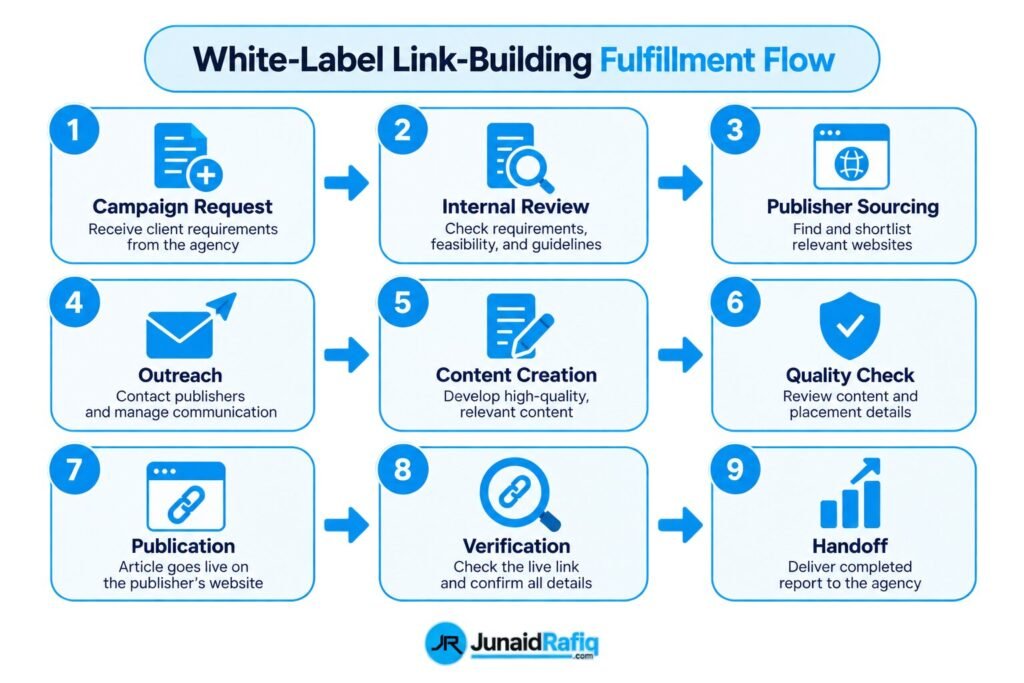
4. Available Publisher Inventory Is Checked
The next part is not simply “find high-DR websites.” Fulfillment teams often work from a larger pool of publisher opportunities.
The challenge is matching that inventory to the actual campaign. A website that works for one client may be completely unsuitable for another.
The quality of the fulfillment process also depends on choosing a white-label link-building partner that can meet the campaign’s requirements consistently.
Relevance
The website should make sense for the campaign.
A technology campaign may have suitable opportunities across software, business, gadgets, startups, and related subjects.
The match does not always need to be exact, but it should be reasonable.
Content Quality
The publication should have content that looks useful to readers.
If the website is filled with thin articles or obvious promotional pages, it may not be suitable even if its SEO metrics look attractive.
Organic Visibility
Search visibility can help provide context about the condition of a website.
A site that has meaningful visibility is different from a domain that exists mainly as a place to publish paid articles.
Website Activity
The team should also look at whether the publication is active.
Recent content, regular updates, and a functioning website provide useful signals about the publication.
Backlink Profile
The site’s backlink profile can provide additional information about its overall condition.
The purpose is not to chase a single metric.
It is to understand what kind of website the fulfillment team is dealing with.
Placement Potential
Finally, the team needs to consider whether the campaign can produce a natural placement on the website.
A good website is not automatically a good opportunity for every campaign.
The specific article and link still need to make sense.
5. Publisher Availability Is Confirmed
A website can appear available in an internal list but still be unavailable for a particular campaign.
A publisher may have changed its pricing, stopped accepting certain niches, paused guest contributions, or already have another article scheduled.
This is why fulfillment requires active publisher management.
The team may need to confirm:
- Current availability
- Current price
- Accepted topics
- Link conditions
- Content requirements
- Expected publishing time
- Any restrictions
This information can change over time.
A publisher database therefore needs regular maintenance rather than being treated as a permanent list.
6. Outreach Is Managed at the Publisher Level
Publisher outreach is where fulfillment becomes highly operational.
The team is not simply sending the same message to every website.
Different publishers can have different requirements, contacts, prices, and response times.
Some may respond within hours.
Others may take several days.
Some may reject the campaign completely.
Others may accept it but request changes to the topic, price, or content.
Keeping Outreach Organized
A fulfillment team needs to know:
- Who was contacted
- When they were contacted
- What they requested
- Whether they replied
- What price was discussed
- Whether the opportunity is still active
- What the next action is
Without tracking, the same publisher can be contacted multiple times by different people.
That creates unnecessary confusion and can damage a working relationship.
7. Publisher Terms Are Recorded
Once a publisher responds, the fulfillment team needs to record the agreed terms.
This is more important than it may appear.
Imagine a publisher agrees to one article, one backlink, a specific topic, and a certain price.
If those details are not recorded, the final placement may not match what was agreed.
The fulfillment record should therefore connect the publisher with the campaign requirements.
This creates a reference point for the rest of the delivery process.
8. Topics Are Coordinated Around the Publication
The next operational challenge is choosing a topic that works for both sides.
The article should support the campaign requirement while also making sense for the publication.
This is not the same as simply inserting an anchor into an existing article.
A new article may need to be planned around the publisher’s audience, subject areas, editorial style, and the client’s target page.
Why Topic Coordination Matters
A weak topic can create problems later.
The publisher may reject it.
The writer may struggle to create a useful article.
The backlink may feel forced.
The agency may then need additional revisions.
Good fulfillment reduces these problems before the article reaches publication.
9. Content Production Is Coordinated
Content is another separate operation inside fulfillment.
Depending on the agreement, the fulfillment team may use an internal writer, an external writer, or another content workflow.
The important part is that the content follows the campaign requirements.
The writer needs the correct:
- Topic
- Target URL
- Anchor text
- Brand information
- Publisher requirements
- Content instructions
- Formatting requirements
The content also needs to sound appropriate for the publication.
A general article written without considering the publication can create unnecessary editorial problems.
10. Content Passes Through Internal Quality Control
The article should not automatically go from writer to publisher.
There should be a quality-control point before publication.
This is one of the places where a fulfillment operation can prevent avoidable mistakes.
The reviewer can check whether the article follows the campaign instructions and whether the backlink has been placed naturally.
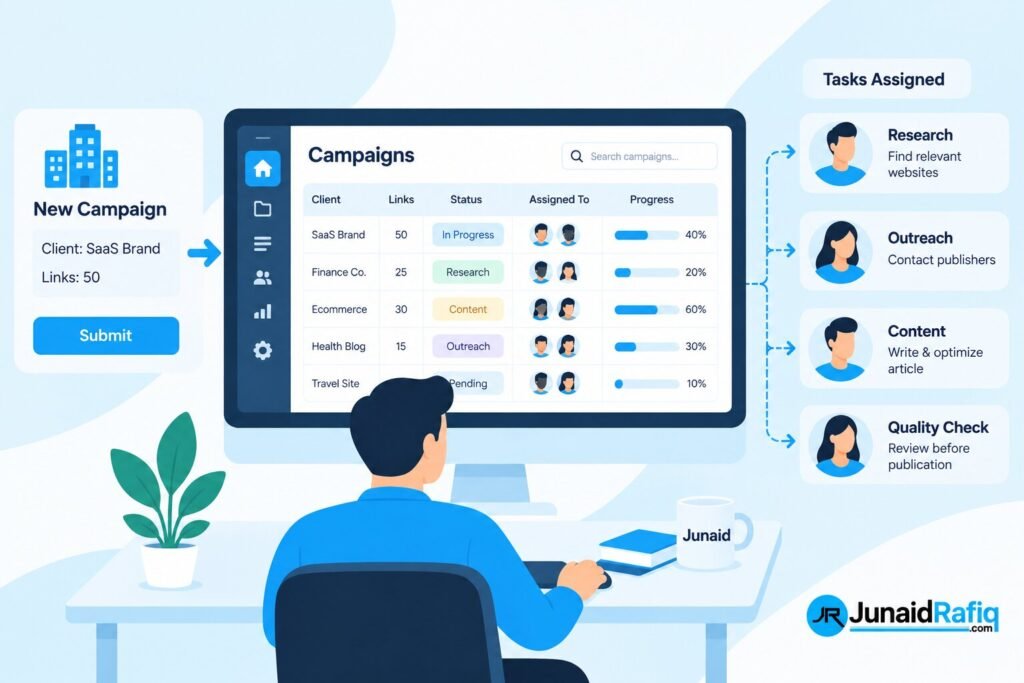
What Can Quality Control Catch?
A review may identify:
- Incorrect anchor text
- Wrong target URL
- Poor formatting
- Missing information
- Weak writing
- Irrelevant sections
- Unnatural link placement
- Publisher-specific requirements that were missed
The exact checklist depends on the agency and fulfillment partner.
The important thing is having a defined review stage rather than relying on someone to notice mistakes after publication.
11. Publication Is Tracked as a Separate Status
Once content has been sent to the publisher, the campaign is not finished.
The article may still be waiting for publication.
This creates another tracking stage.
A fulfillment system should distinguish between:
Content ready
and
Article published
Those are not the same thing.
A publisher can delay publication, request an edit, change a scheduled date, or decide not to publish an article.
The campaign tracker needs to show its current status clearly.
12. Published Links Are Verified Independently
A publisher saying that an article has been published is not the same as completing quality control.
The live page should be checked.
The fulfillment team can verify the publication URL, target URL, anchor text, placement, article accessibility, and other campaign requirements.
This creates a final evidence point.
Why Verification Matters
A small mistake can be missed during the publishing stage.
For example, the article may be live but the wrong URL may have been used.
The anchor may have been changed.
The link may not appear where expected.
The page may also have formatting or accessibility problems.
Verification catches these issues before the placement is marked complete.
13. The Fulfillment Record Is Updated
Once the placement passes verification, the campaign record needs to be updated.
This creates a reliable history of what happened.
A useful fulfillment record can contain:
- Client or campaign name
- Publisher
- Published URL
- Target URL
- Anchor text
- Publication date
- Status
- Cost
- Notes
- Replacement or correction status, if applicable
This information can then be used by the agency for its own records and client reporting.
White-Label Link-Building Fulfillment: From Brief to Delivery
| Fulfillment area | What is managed | Output |
| Campaign intake | Client requirements and restrictions | Clear campaign brief |
| Internal assignment | Ownership and responsibilities | Assigned campaign |
| Publisher inventory | Available website opportunities | Potential placements |
| Publisher coordination | Availability, terms, and pricing | Confirmed opportunity |
| Content coordination | Topic and article requirements | Publication-ready content |
| Quality control | Campaign and content checks | Approved placement |
| Publication tracking | Publishing status and delays | Live or pending placement |
| Verification | Live URL and link checks | Verified placement |
| Record keeping | Campaign and placement data | Complete delivery record |
14. Exceptions Are Handled Instead of Ignored
No fulfillment operation runs perfectly.
A publisher may reject an article.
A website may suddenly stop accepting content.
A writer may miss a requirement.
A placement may go live with the wrong anchor.
A campaign may take longer than expected.
The difference between an organized operation and a messy one is often how these exceptions are handled.
What Happens When a Placement Has a Problem?
- Identify the issue: The fulfillment team confirms exactly what is wrong instead of assuming the placement is acceptable.
- Request a correction: The publisher or writer is contacted with the specific change required.
- Replace the placement when necessary: If the issue cannot be corrected, the placement may need to be replaced according to the agreed terms.
The important part is that the problem has a defined path.
Without one, small issues can remain unresolved until the agency discovers them.
15. Completed Work Is Prepared for Agency Handoff
The final fulfillment stage is preparing the completed campaign information for the agency.
This is more than sending a collection of URLs.
The agency needs enough information to understand what was delivered and verify it against the original order.
A clean handoff makes the fulfillment operation easier for the agency to manage.
What Should a Good Handoff Contain?
A typical handoff can include:
- Live publication URL
- Target URL
- Anchor text
- Publication date
- Publisher information
- Placement status
- Relevant notes
- Any exceptions or changes
The exact format can be a spreadsheet, dashboard, document, or another system.
The important thing is consistency.
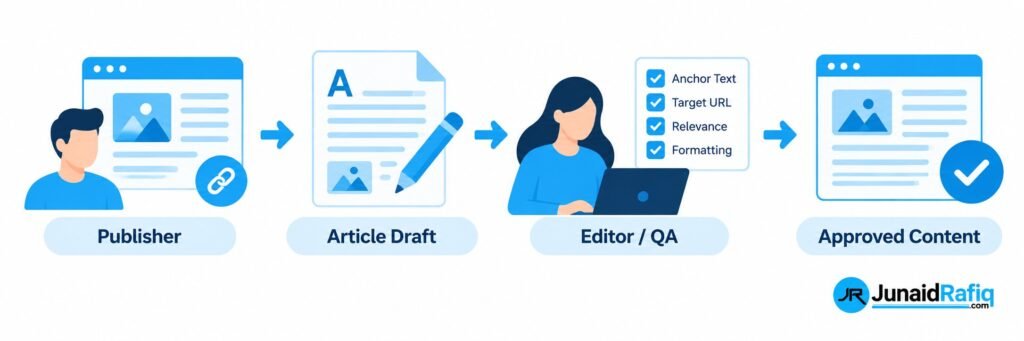
How Fulfillment Teams Manage Multiple Campaigns
One campaign is relatively simple.
Managing dozens of campaigns at the same time is different.
A fulfillment operation needs a system for separating campaigns and tracking their current status.
For example, one campaign might be waiting for publisher confirmation while another is waiting for content and another is ready for final verification.
Without a central tracking system, these campaigns can easily become mixed together.
This is why campaign status matters.
A simple status system might include:
New → In Review → Sourcing → Outreach → Confirmed → Content → Published → Verified → Delivered
The exact labels can differ.
The purpose is to make the current position of every campaign easy to understand.
How Publisher Relationships Affect Fulfillment
Publisher relationships are an operational asset. A fulfillment team that regularly works with publishers can have a better understanding of their requirements, response patterns, pricing, and content expectations.
That knowledge can make campaign management easier. It can also reduce unnecessary back-and-forth.
However, publisher relationships should not replace quality control. A familiar publisher can still make a mistake. A trusted contact can still change terms.
Every completed placement should still be checked against the campaign requirements.
How Fulfillment Handles Delays
Delays are one of the most common operational problems in link-building delivery.
The delay may come from the publisher, content production, revisions, or campaign requirements.
A good fulfillment system should identify delays early.
For example, if a publisher has not responded after several follow-ups, the team may need to move to another opportunity rather than allowing the campaign to sit idle.
The agency also benefits when delays are communicated clearly.
Silence creates uncertainty.
A short status update can tell the agency whether the campaign is progressing, waiting on a publisher, or requires a decision.
What Happens When Campaign Requirements Change?
Client campaigns can change after fulfillment has already started.
The agency may change the target page. The client may request a different anchor. The niche may change. The number of placements may increase. A new country may be added.
These changes need to be recorded rather than handled informally. Otherwise, one part of the fulfillment team may continue using the old requirements while another person is working from the new instructions.
A controlled update keeps everyone working from the same information.
What Agencies Should Understand About Fulfillment Capacity
Fulfillment capacity is not simply the number of backlinks a provider says it can deliver.
Capacity depends on the whole operation.
If demand increases, the system may need to handle more publisher research, outreach, content, reviews, corrections, and reporting at the same time.
For example, an operation that comfortably handles 20 placements may need different systems when it begins handling hundreds.
The important question is whether each stage can continue working without creating a large backlog.
This is where processes, tracking, publisher relationships, and clear ownership become important.
How Quality Control Fits Into Fulfillment
Quality control should not happen only at the end.
There can be several checkpoints during fulfillment. The campaign brief can be checked before sourcing. Publisher opportunities can be checked before confirmation. Content can be reviewed before submission.
Published placements can be verified after publication. This creates several opportunities to catch errors.
A single final check is useful, but several smaller checks can prevent mistakes from moving further through the system.
What Agencies Should Receive From a Fulfillment Partner
The agency does not need every internal message or every rejected publisher.
What it needs is useful delivery information.
A clean handoff should make it easy to answer basic questions:
What was ordered?
What was delivered?
Where was it published?
Does the placement meet the requirements?
Is anything still pending?
This keeps the agency’s internal work focused on reviewing and using the completed information rather than reconstructing what happened during fulfillment.
Why a Fulfillment System Needs Documentation
Documentation may not be visible to the client, but it is important for consistency.
When a campaign is documented properly, another team member can understand its status without starting from zero.
This becomes especially useful when:
- A campaign is transferred between team members.
- A publisher asks about an old order.
- An agency requests a correction.
- A placement needs to be replaced.
- A client asks about an older backlink.
Good records turn individual transactions into a repeatable operation.
What Makes White-Label Fulfillment Different From Simple Link Reselling?
Selling a link and fulfilling a campaign are not necessarily the same thing.
Selling a link and fulfilling a campaign are not necessarily the same thing. The operational model can also differ depending on whether an agency handles the work internally or uses an external fulfillment operation. White-label vs. in-house involves different responsibilities, resources, and delivery structures.
A simple reseller model may involve purchasing an available placement and passing the details to an agency.
Fulfillment can involve much more operational work.
The team may need to manage campaign requirements, publisher communication, content, quality checks, tracking, corrections, and delivery.
That is why fulfillment should be viewed as a service operation rather than just access to a website list.
The value is in managing the work around the placement.
Frequently Asked Questions
What does white-label link-building fulfillment include?
It can include campaign intake, internal assignment, publisher sourcing, outreach, publisher coordination, content management, quality control, publication tracking, verification, issue handling, and final delivery. The exact responsibilities depend on the agreement between the agency and fulfillment partner.
Who manages the publisher during fulfillment?
Usually, the fulfillment team handles publisher communication when that responsibility is included in the service. This can include availability checks, pricing, topic discussions, content requirements, publication status, and corrections.
Why does a fulfillment team need campaign tracking?
Because several campaigns can be active at the same time. Tracking helps the team know which campaigns are waiting for publishers, content, publication, verification, or corrections. It also reduces the chance of mixing requirements between clients.
What happens if a publisher rejects a campaign?
The fulfillment team may look for another suitable opportunity, depending on the campaign requirements and the agreed process. The important part is that the rejected opportunity is recorded so the same issue does not keep repeating.
How is a published backlink checked?
The live page can be reviewed against the campaign requirements. This may include checking the publication URL, target URL, anchor text, placement, article, and whether the page is accessible. Any issue can then be sent for correction or handled through the replacement process.
Can white-label fulfillment handle large numbers of campaigns?
It can, but capacity depends on the systems and resources supporting the operation. Larger campaign volumes require organized tracking, sufficient publisher opportunities, clear ownership, content capacity, quality control, and consistent communication.
Final Thoughts
White-label link-building fulfillment is the operational work that turns an agency’s campaign requirements into completed placements.
It is not just about finding a website.
It involves managing campaign information, allocating work, coordinating publishers, keeping content moving, checking quality, tracking publication, resolving exceptions, verifying completed placements, and preparing accurate delivery information.
That work happens behind the scenes, but it directly affects how smoothly an agency can deliver its link-building service.
When fulfillment is organized, every campaign has a clear place in the system.
When it is not, small problems can quickly become missed requirements, delays, corrections, and extra work for the agency.
For that reason, fulfillment should be treated as a complete operational function, not simply the final step of getting a backlink.
Need Help With Link-Building Fulfillment?
Managing publishers, content, outreach, quality checks, and delivery can take a lot of time when you’re running multiple client campaigns.
If you need a reliable fulfillment partner behind the scenes, I can help manage the operational side of your link-building campaigns while you stay focused on your clients.
Want to discuss your requirements? Book a meeting with me and let’s talk about your campaign.