Running an SEO agency can look simple from the outside.
You get a client, create a strategy, work on the website, build links, and report the results.
In reality, every part of that process takes time.
Link building can be one of the more demanding parts. Finding suitable websites is only the beginning. Someone has to research prospects, handle outreach, communicate with publishers, coordinate content, check placements, and keep records of everything that has been delivered.
That becomes harder as an agency grows.
You might start with two or three clients and handle everything yourself. Then you have 10 clients, 20 clients, or more. The work keeps growing, but your team doesn’t always grow at the same speed.
This is where white-label link building can become useful.
If you’re looking for a reliable partner to support your agency’s link-building campaigns, you can learn more about my link-building services.
Instead of handling every part of link building internally, an SEO agency works with another company that helps fulfill the service. The agency keeps the client relationship and can offer the service under its own brand.
But what exactly does that mean, and how does it work?
Let’s take a closer look.
What Is White-Label Link Building?
White-label link building is a business arrangement where an SEO agency uses an external provider to help deliver link-building services to its clients.
The provider works behind the scenes.
The SEO agency remains responsible for the client relationship, strategy, and overall service. The outside partner handles the link-building tasks that the agency has agreed to outsource.
For example, an agency might sell a monthly SEO package that includes link building.
Instead of having its own employees find every website and manage every publisher conversation, the agency can send the campaign requirements to a white-label partner. That partner then works on the agreed placements and sends the completed work back to the agency.
The agency reviews the work and reports it to the client.
That’s the basic idea.

The important thing is that white-label link building is not a different type of backlink. It’s a way of delivering link-building services.
The actual links still need to be evaluated based on things such as relevance, content quality, website quality, and how naturally they fit into the content.
What Does “White-Label” Mean for an SEO Agency?
The term “white-label” is used in many industries.
The idea is straightforward: one company does some of the work, while another company sells the finished service under its own brand.
In SEO, this can allow an agency to expand what it offers without building every capability internally.
Imagine an agency that is very good at technical SEO and content strategy but doesn’t have a large outreach team.
The agency can still offer link building to its clients by working with a specialist provider.
The client deals with the agency.
The agency deals with the fulfillment partner.
The partner handles the agreed work in the background.
Of course, the exact setup can be different from one agency to another. Some agencies outsource almost the entire link-building operation, while others use outside providers only when their internal team reaches capacity.
How White-Label Link Building Fits Into an SEO Agency
The easiest way to understand the model is to look at where it sits in the agency’s existing workflow.
The client comes to the agency with an SEO goal.
The agency develops the strategy and decides whether link building should be part of the campaign. If the agency chooses to use a white-label provider, it sends the necessary campaign information to that provider.
The provider works on the agreed tasks.
The finished placements and campaign information return to the agency, and the agency handles the client-facing side.
So the relationship is roughly:
Client → SEO Agency → White-Label Partner → SEO Agency → Client

The agency remains at the center.
This is important because white-label fulfillment shouldn’t mean giving away responsibility for the campaign. The agency still needs to understand what it is delivering and why those placements make sense for the client.
How Does White-Label Link Building Work?
There isn’t one standard process that every provider follows.
Some providers focus on publisher relationships. Others specialize in outreach, guest post placements, niche edits, or particular industries.
But the general process is fairly simple.
The SEO Agency Starts With the Client’s Requirements
The agency first needs to understand what the campaign requires.
That might include the client’s website, target pages, industry, preferred topics, geographic market, and the type of placements the agency wants.
The more clearly these requirements are communicated, the easier it is for the fulfillment partner to understand what a suitable opportunity looks like.
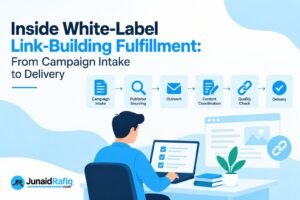
The White-Label Partner Handles the Agreed Work
The partner then takes care of the parts of the campaign included in the agreement.
That may involve researching websites, contacting publishers, coordinating content, securing placements, and documenting the finished work.
The agency doesn’t necessarily need to manage every email or publisher conversation.
That’s one of the main reasons to use a fulfillment partner.
The Agency Reviews and Delivers the Work
Once placements are completed, the information goes back to the agency.
The agency can review the work before including it in its client report.
This step matters.
White-label does not mean “accept everything without checking it.” The agency’s reputation is still connected to the work it delivers.

Why Do SEO Agencies Use White-Label Link Building?
The reasons vary.
For some agencies, it’s about saving time. For others, it’s about taking on more clients without immediately hiring more people.
The biggest advantage is usually flexibility.
An agency may have a strong internal SEO team but not enough people to handle a sudden increase in link-building demand. Hiring several employees for a temporary increase in workload isn’t always practical.
A white-label partner can provide additional capacity when needed.
It can also help an agency offer link building when the service isn’t its main area of expertise.
For example, a small agency might be excellent at local SEO but have limited experience with large-scale outreach. Working with a specialist can allow the agency to offer a broader service without trying to build everything from zero.
There is also a management benefit.
Running an internal link-building operation means managing people, training staff, maintaining processes, handling software, monitoring campaigns, and dealing with day-to-day problems.
Some agencies prefer to keep their internal team focused on strategy and client work while an outside specialist handles fulfillment.
What Can a White-Label Link-Building Partner Help With?
The answer depends on the provider and the agreement.
A partner may help with finding potential websites, outreach, content coordination, link placement, and reporting.
The important point is that agencies should understand exactly what they are outsourcing.
For example, one provider may only supply website opportunities, while another may manage the entire campaign from prospecting through publication.
Neither approach is automatically wrong.
It simply means the agency needs to know what it is paying for.
What Should Agencies Look For in White-Label Link Building?
This is probably the most important part of the decision.
The white-label market includes providers with very different approaches to quality.
A provider may have thousands of websites in an inventory. That sounds impressive, but the number alone doesn’t tell an agency whether those websites are useful.

A smaller inventory can sometimes be more valuable if the sites are relevant, maintained, and genuinely useful to readers. If you’re ready to compare providers, learn how to choose the right white-label link-building partner.
Website Relevance Matters
A backlink should make sense in context.
If a client operates a software company, a relevant technology or business publication may be a natural fit.
A completely unrelated website with a high third-party metric is a different story.
Relevance doesn’t guarantee that a link will improve rankings, but it is an important part of judging whether a placement makes sense.
Look Beyond Third-Party Metrics
Metrics such as Domain Rating, Domain Authority, and similar scores can be useful when comparing websites.
But they are not the entire picture.
An agency should also look at the website’s content, search visibility, audience, backlink profile, and general condition.
A high score on one SEO tool doesn’t automatically make a website a good publication.
Pay Attention to the Content
Look at the articles already published on the website.
- Do they provide useful information?
- Do they cover a clear subject?
- Do they appear to be written for actual readers?
Or does every article look like it exists mainly to sell a backlink?
That difference is easy to overlook when someone is focused only on metrics.
Think About the Placement, Not Just the Website
Even a good website doesn’t make every placement good.
The article should be relevant to the publication, and the backlink should fit naturally into the content.
A useful editorial mention is much more convincing than a link that has been forced into an unrelated paragraph.
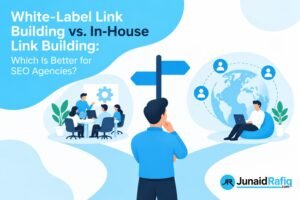
The Main Difference Between White-Label and In-House Link Building
Both models can work.
The difference is mainly about who handles the work.
| White-label link building | In-house link building |
| External partner handles agreed fulfillment | Internal team handles fulfillment |
| Easier to add capacity quickly | Greater direct control over the process |
| Less hiring and training required | Requires recruitment and team management |
| Partner relationships can provide additional opportunities | Agency builds its own relationships |
| Agency manages the client relationship | Agency manages both clients and fulfillment |
For a growing agency, the decision usually comes down to resources, workload, expertise, and how much control the agency wants.
There is no rule saying an agency must choose one model forever.
Some agencies start with outside fulfillment and gradually build internal capabilities as they grow. Others keep a hybrid model for years.
What Are the Benefits of White-Label Link Building?
The biggest benefit is that an agency can separate selling the service from doing every task required to fulfill it.
That can create more room for growth.
An agency may be able to accept additional campaigns without immediately expanding its internal team. It can also spend more time on client strategy, reporting, and account management.
Another benefit is specialization.
A link-building provider that works on campaigns every day may already have established processes and publisher relationships. An agency doesn’t necessarily need to build all of those from scratch.
But these benefits only matter when the partner can meet the agency’s standards.
Outsourcing poor-quality work doesn’t solve an agency’s problems. It simply moves the problem somewhere else.
Is White-Label Link Building Right for Your Agency?
It can be a good fit for agencies that already sell SEO services and want more link-building capacity.
It can also make sense for agencies that don’t want to hire and manage a dedicated outreach team yet.
A simple question can help:
Do we need to perform all of this work ourselves to deliver a good service to our clients?
If the answer is no, outside fulfillment may be worth considering.
On the other hand, an agency with a strong internal outreach team, established publisher relationships, and enough workload to support that team may prefer an in-house model.
The goal isn’t to follow what another agency is doing.
The goal is to choose a delivery model that fits your own business.
What to Consider Before Working With a White-Label Link-Building Partner
Before signing up with a provider, look at the actual work behind the sales pitch.
- Ask how websites are analyzed.
- Ask what happens when a placement doesn’t meet the agreed requirements.
- Ask how completed work is reported.
- Ask how communication works.
And, most importantly, review examples of the websites and placements they provide.
Price matters, especially when an agency has many clients.
But the cheapest placement isn’t necessarily the best value.
If your agency delivers a poor placement to a client, the cost isn’t limited to that one backlink. You may have to spend time fixing the issue, explaining it to the client, or replacing the placement.
That’s why the right partner should be judged on the whole service rather than price alone.
Common Misunderstanding: White-Label Doesn’t Mean Risk-Free
There is a temptation to think that outsourcing means the provider becomes responsible for everything.
It doesn’t.
Your client still sees your agency’s name.

If the work is poor, the client is unlikely to blame a company they’ve never heard of. They’ll blame the agency they hired.
That is why an agency should have its own standards for the work it accepts.
White-label fulfillment can reduce operational work, but it doesn’t remove the need for good judgment.
You still need to know what a good opportunity looks like.
You still need to understand your client’s niche.
And you still need to review what is being delivered.
Final Thoughts
White-label link building is simply a way for SEO agencies to use an outside specialist to help deliver link-building services under the agency’s own brand.
The model can help agencies increase capacity, serve more clients, and reduce some of the day-to-day work involved in link building.
But the real value isn’t the word “white-label.”
It’s the quality of the fulfillment behind it.
A provider with a huge list of websites isn’t automatically a good partner. What matters is whether the opportunities make sense, whether the content is useful, whether placements are relevant, and whether the agency can confidently put its name behind the finished work.
For SEO agencies, that’s the part worth paying attention to.
Because your client may never know who helped build the links.
They will know who delivered them.
Need reliable link-building support for your agency? Get in touch with me to discuss your requirements.