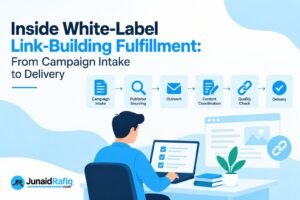
Building backlinks is an important part of SEO, but how an agency handles link building can have a major impact on its costs, workflow, margins, and ability to grow.
Some SEO agencies build links with an internal team. They hire outreach specialists, content writers, SEO managers, and link builders to handle campaigns from start to finish.
Others work with a white-label link-building partner. The agency sells the service to its clients while an outside team handles the research, outreach, content, and placements behind the scenes.
Both models can work. The better choice depends on the agency’s budget and time.
If you are trying to decide between building an internal link-building team and using a white-label partner, the main question is not simply which option provides backlinks.
The better question is:
Which model allows your agency to deliver quality link-building campaigns while managing costs, workload, control, and growth effectively?
This guide compares white-label and in-house link building across the areas that matter most to SEO agencies.
What Is In-House Link Building?
In-house link building means your agency handles the link-building process with its own employees or contractors.
The agency controls the people working on campaigns, the outreach process, content production, publisher relationships, quality checks, and campaign management.
An internal team may include:
- Link builders and outreach specialists
- Content writers and editors
- SEO specialists
- Campaign managers
- Account managers
The exact team depends on the agency’s size and the number of campaigns it manages.
For a small agency, one person may handle several of these responsibilities. A larger agency may have separate teams for outreach, content, quality control, and account management.
The biggest advantage of this model is control.
Your agency can decide how campaigns are managed, which websites are contacted, what type of content is produced, and what quality standards are followed.
However, that control comes with additional responsibility.
The agency must find and hire suitable people, train them, manage their workload, build publisher relationships, maintain processes, and deal with capacity when client demand increases.
What Is White-Label Link Building?
White-label link building is a model where an external provider handles link-building work for an SEO agency.
The SEO agency remains the client’s main point of contact.
The client may never know that another company is involved in the delivery process.
The white-label provider can handle parts or most of the campaign, including prospect research, outreach, content, link placement, and reporting.
This allows an SEO agency to offer link building without building every part of the operation internally.
For agencies that already have clients but do not want to hire a large link-building team, this can be an attractive option.
The agency can focus more of its internal resources on strategy, client communication, sales, and account management while the fulfillment partner handles the operational work.
For a deeper explanation of the model, see our guide to what white-label link building is.
White-Label vs. In-House Link Building: The Main Difference
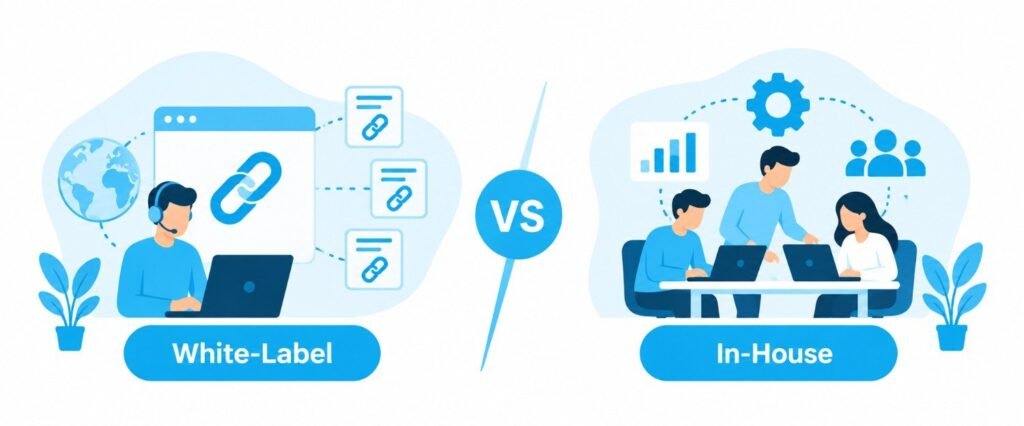
The main difference between the two models is who owns and manages the link-building operation.
With in-house link building, the SEO agency owns the team, processes, publisher relationships, and day-to-day campaign work. With white-label link building, an external partner handles some or all of the fulfillment while the agency manages the client relationship.
Neither model is automatically better. The right choice depends on the agency’s budget, workload, growth plans, quality standards, and desired level of control.
Cost and Overall Expenses
Cost is one of the first factors an agency should consider when comparing these models.
At first glance, in-house link building may appear cheaper because the agency is not paying an external provider for each placement. However, employee salaries are only one part of the total cost.
An internal operation can also require recruitment, training, software, management, content production, outreach infrastructure, quality control, and publisher development.
There is also the cost of unused capacity.
For example, an agency may build an internal team capable of handling 100 placements per month but only have enough client work for 50. The agency still has to pay its employees and maintain its systems even when demand is lower.
White-label link building creates a different cost structure.
Instead of carrying the full cost of an internal team, the agency pays a provider for the fulfillment it needs. This can make costs easier to manage when campaign volume changes.
However, agencies still need to protect their margins. A white-label provider should offer pricing that leaves enough room for the agency to cover account management, strategy, overhead, and profit.
Hiring and Training
Building an in-house link-building team takes time.
Finding people who understand prospecting, outreach, publisher requirements, content quality, SEO basics, and campaign management can be difficult. Even after hiring the right people, they need time to learn the agency’s processes and client requirements.
New employees may also need training in outreach methods, prospect evaluation, content standards, reporting, and quality control.
This is not necessarily a disadvantage. A strong internal team can become a valuable long-term asset for an agency.
The problem is the resources required to build that team.
White-label fulfillment removes much of this work because the provider already has people and processes in place. Instead of spending weeks or months creating an operation from scratch, an agency can start with an established fulfillment system.
This can be particularly useful when an agency’s client base is growing faster than its ability to hire.
Scalability
Scalability is another major difference between the two models.
Imagine an agency has 10 clients requesting link building. Over the next few months, it signs another 20 clients.
An internal team may suddenly become overloaded. The agency may need to hire additional staff, train them, assign managers, and make sure quality does not decline as the workload increases.
A white-label partner may already have the capacity to handle additional campaigns.
That does not mean every provider can scale indefinitely. Agencies still need to check a provider’s capacity, turnaround times, quality standards, and communication process.
The advantage is flexibility.
An agency can increase or reduce fulfillment according to client demand without necessarily changing the size of its internal team.
Control Over the Campaign
In-house link building has a clear advantage when it comes to direct control.
The agency manages the entire process and can create its own standards for prospecting, outreach, content, approvals, and quality checks.
If a client has unusual requirements, the internal team can be trained to follow them.
White-label link building provides less direct operational control because another company is responsible for part of the fulfillment.
This makes the relationship with the provider especially important.
A reliable partner should be able to follow the agency’s campaign requirements instead of using exactly the same process for every client.
The agency should also have a clear review process for checking placements before they are delivered to clients.
Quality of Backlinks
The quality of backlinks depends more on the process and standards being used than on whether the work is performed internally or externally.
An in-house team can build excellent links, but it can also produce poor results if it relies on weak websites or focuses too heavily on volume.
The same applies to white-label providers.
A good provider can give an agency access to strong publications and experienced outreach specialists. A poor provider can deliver low-quality placements that hurt the agency’s reputation with clients.
Agencies should therefore look beyond metrics such as Domain Rating or Domain Authority.
A useful evaluation should consider:
- Relevance to the client’s industry, real organic traffic, indexing, content quality, website activity, and the overall legitimacy of the publication.
A high authority metric alone does not guarantee a valuable backlink. Agencies should also avoid link-building practices that violate Google’s link spam policies.
Publisher Relationships
Publisher relationships can take a long time to develop.
An internal team has to discover suitable websites, contact publishers, negotiate terms, manage conversations, and maintain those relationships over time.
This can become a major operational task as the agency grows.
Established white-label providers may already have relationships with a large number of publishers. This can give an agency access to potential placements without requiring its internal team to build every relationship from scratch.
However, agencies should still ask how the provider sources and evaluates its websites.
A large database does not automatically mean a high-quality network.
The important question is whether the available publications match the agency’s clients, industries, quality requirements, target countries, and budgets.
Turnaround Time
An established internal team can deliver campaigns quickly once its processes are working well.
The challenge is getting to that point.
A new employee may need several weeks before becoming fully productive. Publisher relationships also take time to develop, and new campaigns may require additional research before outreach begins.
White-label fulfillment can provide a faster starting point because the provider already has its team, systems, and publisher relationships in place.
This can be useful when an agency needs to launch campaigns quickly.
However, turnaround time depends heavily on the provider. A partner handling too many orders may create delays, while an organized provider may offer more predictable delivery.
Before choosing a partner, agencies should understand the expected timeline from campaign submission to final placement.
Management and Workload
An internal team creates another management responsibility for the agency.
Someone needs to assign work, monitor performance, resolve problems, train employees, review campaigns, track placements, and manage capacity.
For a larger agency with dedicated managers, this may be reasonable.
For a smaller agency, however, managing fulfillment can take time away from higher-value activities such as SEO strategy, sales, and client relationships.
White-label fulfillment can reduce this operational workload.
The agency still needs to manage the provider relationship and review results, but it does not have to manage every outreach specialist, writer, or publisher conversation directly.
This can give the core agency team more time to focus on activities that directly support growth.
Client Experience
From the client’s perspective, the most important thing is the quality of the service and the results they receive.
They usually do not care whether a backlink was secured by an employee sitting inside the agency or by a trusted fulfillment partner working behind the scenes.
With a white-label model, however, the agency remains responsible for the client relationship.
That means the agency should understand what its fulfillment partner is doing and should review the work before presenting it to the client.
It should not simply forward whatever the provider delivers.
A strong white-label process should allow the agency to maintain its own quality standards, reporting format, communication style, and client experience.
When handled correctly, the client can receive the same professional service regardless of where the fulfillment work takes place.
Margins and Pricing
White-label link building can be attractive to agencies because it creates an opportunity to sell fulfillment at a higher client-facing price.
For example, an agency may purchase a placement from a provider at a wholesale rate and include that placement in an SEO package or sell it directly to a client.
The difference between the fulfillment cost and the client price can help cover strategy, account management, sales, overhead, and profit.
But the numbers need to make sense.
If a provider’s pricing is too close to the agency’s selling price, there may not be enough room for a healthy margin.
Agencies should therefore compare wholesale pricing with expected client pricing before choosing a provider.
They should also consider minimum order requirements, turnaround times, replacement policies, content costs, quality standards, and the amount of internal management required.
The cheapest provider is not necessarily the most profitable option. A slightly higher fulfillment cost may produce better margins if it saves the agency significant time and reduces quality-control problems.
Comparison: White-Label vs. In-House Link Building
| Factor | White-Label Link Building | In-House Link Building |
| Initial setup | Fast | Slower |
| Hiring required | Usually no | Yes |
| Training burden | Low | High |
| Direct control | Moderate | High |
| Scalability | High, depending on provider capacity | Depends on hiring |
| Publisher relationships | Often already established | Must be developed |
| Fixed overhead | Lower | Higher |
| Management workload | Lower | Higher |
| Customization | Depends on provider | High |
| Operational ownership | External partner | Internal team |
| Speed to launch | Usually faster | Usually slower |
| Profit potential | Depends on wholesale pricing | Depends on internal efficiency |
| Best for | Agencies seeking flexible fulfillment | Agencies wanting full operational control |
When In-House Link Building Makes More Sense
In-house link building can be a strong choice for agencies with enough recurring demand to justify a dedicated team.
It may also make sense when link building is one of the agency’s core competitive advantages.
For example, an agency that specializes in highly customized outreach campaigns may want complete control over prospect research, relationships, content, and communication.
An internal team can also make sense when the agency has the management resources to support it.
If you already have experienced staff, established processes, and enough consistent work, bringing fulfillment in-house can become more efficient over time.
The key is having enough volume to keep the team productive.
When White-Label Link Building Makes More Sense
White-label fulfillment is often a better fit when an agency wants to sell link building without taking on the full operational burden.
It can be especially useful for agencies that:
- Want to scale client campaigns without constantly hiring new employees.
- Need access to publishers without building every relationship themselves.
- Have limited internal link-building resources.
- Want flexible fulfillment as client demand changes.
- Prefer to focus their internal team on SEO strategy and client management.
The model can also help agencies test demand.
Instead of hiring a complete team before knowing how much link-building work clients will purchase, an agency can use a fulfillment partner and build internal capacity later if demand becomes consistent.
What About a Hybrid Model?

The choice does not always have to be white-label or in-house.
Some agencies use both.
For example, an agency may keep strategy, prospect approval, quality control, and important client campaigns in-house while using a white-label partner for additional fulfillment.
This creates a hybrid operation.
The internal team handles the parts where the agency wants the most control.
The external partner handles additional volume when the agency’s internal capacity is not enough.
This approach can work well as an agency grows.
An agency may start with fully outsourced fulfillment, build an internal team over time, and eventually use outside support only during periods of high demand.
How Should an SEO Agency Decide?
There is no universal answer.
The right model depends on your current client volume, internal resources, budget, growth plans, and desired level of control.
Ask yourself a few practical questions.
How many link-building campaigns do you currently manage?
How many do you expect to manage six or twelve months from now?
Do you already have experienced link builders?
How much time does your team spend managing outreach and publishers?
Would hiring additional employees increase your profit, or would it simply increase overhead?
Do you have enough publisher relationships to support your current and future clients?
And most importantly, where does your agency create the most value?
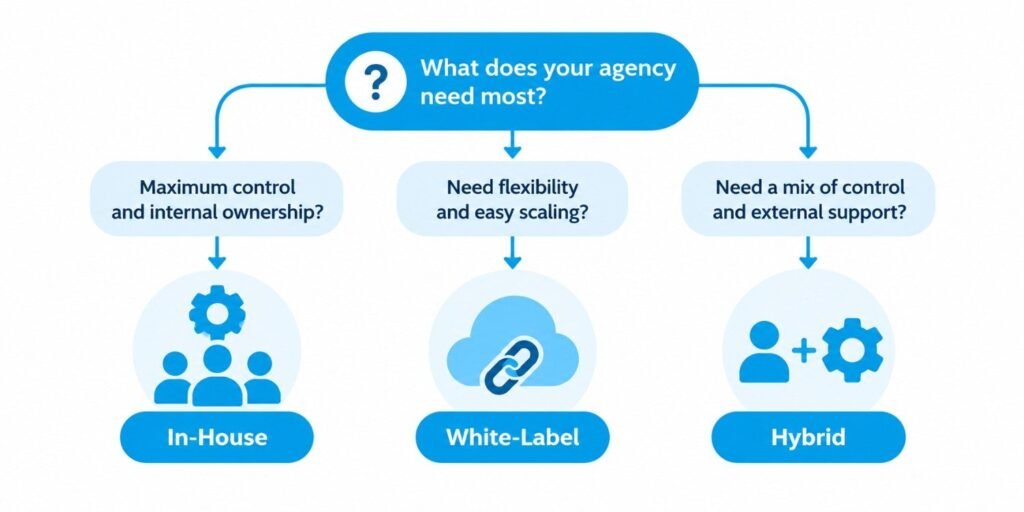
If your strongest skills are strategy, client acquisition, technical SEO, content strategy, or account management, outsourcing fulfillment may allow your team to focus on those areas.
If your agency has strong expertise in outreach and wants to own every part of the process, an internal operation may be the better investment.
What to Look for in a White-Label Partner
If you choose white-label fulfillment, the partner you select becomes an important part of your delivery system.
Do not choose a provider based only on the cheapest price. The right white-label link-building partner should also meet your standards for website quality, communication, turnaround times, content, reporting, and campaign requirements.
You should also check whether the provider can support your agency as your client base grows.
A partner that works well for five campaigns may not be suitable for 50.
The goal is not simply to find someone who can build links.
The goal is to find a fulfillment partner that can consistently deliver work your agency is comfortable putting in front of clients.
The Real Cost of In-House vs. White-Label
The simplest way to compare these models is to look beyond the price of a single backlink.
In-house link building has a broader operational cost.
You are paying for employees, management, software, training, infrastructure, and the time required to maintain the operation.
White-label link building has a different cost.
You pay the provider for fulfillment, but you give up some operational control and depend on another company to deliver the work.
Neither cost structure is automatically better.
The right choice is the one that produces the best combination of quality, efficiency, control, and profit for your agency.
Final Verdict: Which Is Better?
For SEO agencies, white-label and in-house link building can both be effective.
In-house link building is generally better when control, customization, and internal expertise are the priority.
White-label link building is generally better when flexibility, scalability, and lower operational overhead are the priority.
For many growing agencies, white-label fulfillment can be a practical way to increase capacity without immediately building a large internal team.
For established agencies with consistent demand and strong internal processes, bringing more of the work in-house may make financial and operational sense.
There is also a third option: use a hybrid model and keep strategic or sensitive work internal while using a trusted partner for additional fulfillment.
The most important decision is not whether outsourcing is better than hiring.
It is whether your current link-building model supports the direction your agency wants to take.
If your agency is spending too much time hiring, training, managing outreach, and building publisher relationships, white-label fulfillment may give your team more room to focus on growth.
If you already have the people, processes, and volume to run a profitable internal operation, keeping link building in-house may provide the control you need.
The best model is the one that lets you deliver reliable link-building campaigns while protecting your agency’s quality, margins, and ability to scale.