A real-world look at publisher outreach, guest posts, niche edits, and Google Search Console performance for a SaaS startup.
The Project: Building Visibility for a SaaS Startup
Growing a SaaS business through organic search takes more than publishing content and waiting for rankings to improve. Search visibility depends on several factors, including the quality of a website’s content, its technical health, its relevance to search queries, and the authority signals it earns over time.
Link acquisition can play an important role in that process.
For this project, I personally handled digital PR outreach and link-building activities for a SaaS startup. My work included contacting publishers, securing link placements, pursuing guest-post opportunities, and identifying existing articles where relevant backlinks could be placed.
The goal was to support the website’s visibility by pursuing relevant publishing opportunities and building relationships with publishers.
Google Search Console subsequently showed substantial search performance during the reporting period. Although the data does not prove that link building alone produced the increase, it provides a useful view of the website’s organic search performance while the campaign was being carried out.
The Link-Building Strategy
Rather than relying on a single link-acquisition method, the campaign involved several approaches. Each offered a different way to pursue relevant placements and build connections with publishers.
1. Publisher Outreach
Publisher outreach was a central part of the work.
The process involved identifying potential publishing opportunities, reviewing their suitability, and contacting publishers to discuss possible placements.
Good outreach requires more than sending the same message to hundreds of websites. A publisher needs a reason to consider the proposed content or link, and the opportunity needs to make sense in the context of the publication.
I focused on outreach as a way to identify relevant opportunities and move conversations toward potential placements.
2. Guest Posts
Guest posting provided another route to securing placements on relevant websites.
The approach involves contributing useful content to an external publication where the subject fits its audience. When a backlink is included, it should make sense within the article rather than feel added solely for SEO purposes.
For SaaS businesses, relevant publications can also introduce a brand to readers who may not have discovered it through the company’s own website.
The value of a placement therefore depends on more than the presence of a link. Relevance, editorial context, and the quality of the publication all matter.
3. Link Insertions and Niche Edits
I also worked on link insertion opportunities, commonly called niche edits.
Instead of creating an entirely new article, this method involves identifying an existing page where a relevant reference could add value for readers.
The important part is the fit. An existing article should genuinely relate to the target page, and the proposed link should provide useful additional information.
A placement on an established, relevant page can be worth considering, but an older article or a high third-party authority score does not automatically make a backlink valuable.
4. Digital PR Outreach
Digital PR outreach was another part of the campaign.
Digital PR focuses on earning attention and coverage from relevant publications through outreach, useful resources, stories, or information that publishers may want to reference.
It differs from simply purchasing a placement because the emphasis is on developing a reason for a publication to cover or reference a brand.
For SaaS companies, this can create opportunities to build brand awareness alongside potential backlinks. However, publication coverage and links are not guaranteed, and outcomes depend on the strength of the story, the target publications, and their editorial decisions.
How I Approached Link Opportunities
A successful link-building campaign should not be measured only by the number of links acquired.
A large backlink count can look impressive in a report, but it does not automatically tell you whether those links are relevant, editorially appropriate, or useful to the website.
During outreach and opportunity evaluation, the key considerations included the relationship between the publishing website, its content, and the target business.
Relevance matters because a link should fit naturally into its surrounding subject. Content quality matters because the page needs to serve readers. Placement context matters because a link buried in unrelated content is not equivalent to a meaningful editorial reference.
Publisher communication also requires follow-up and record-keeping. Outreach records help track conversations and potential opportunities, although a contacted publisher should not be counted as a successful placement until the link has actually been published and verified.
I retained outreach records for this project. Because I do not have a complete set of verified published URLs, I am not presenting an exact number of acquired backlinks or claiming that every outreach opportunity resulted in a live link.
Google Search Console Results
The website’s Google Search Console screenshots show a substantial difference between the two selected reporting periods.
The earlier period ran from April 28 to June 27, 2026. The later period ran from June 28 to September 27, 2026.
Organic Search Performance
| Metric | April 28 – June 27, 2026 | June 28 – September 27, 2026 |
|---|---|---|
| Total clicks | 85 | 5,530 |
| Total impressions | 10,700 | 1,410,000 |
| Average position | 34.3 | 7.2 |
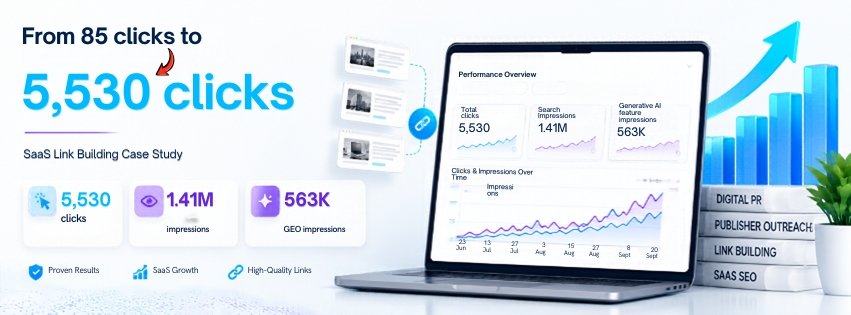
The later reporting period recorded 5,530 clicks and 1.41 million impressions, compared with 85 clicks and 10,700 impressions in the earlier period.
The average position also changed from 34.3 to 7.2. This is a substantial improvement in the reported aggregate metric, although it does not mean that every keyword reached the first page.
These figures describe the website’s overall reported search performance. They do not isolate the contribution of the link-building campaign from other possible influences, such as content updates, technical changes, new pages, changes in demand, or Google’s search systems.
The reporting periods also differ in length, so their totals should not be treated as a direct comparison of equal time periods.
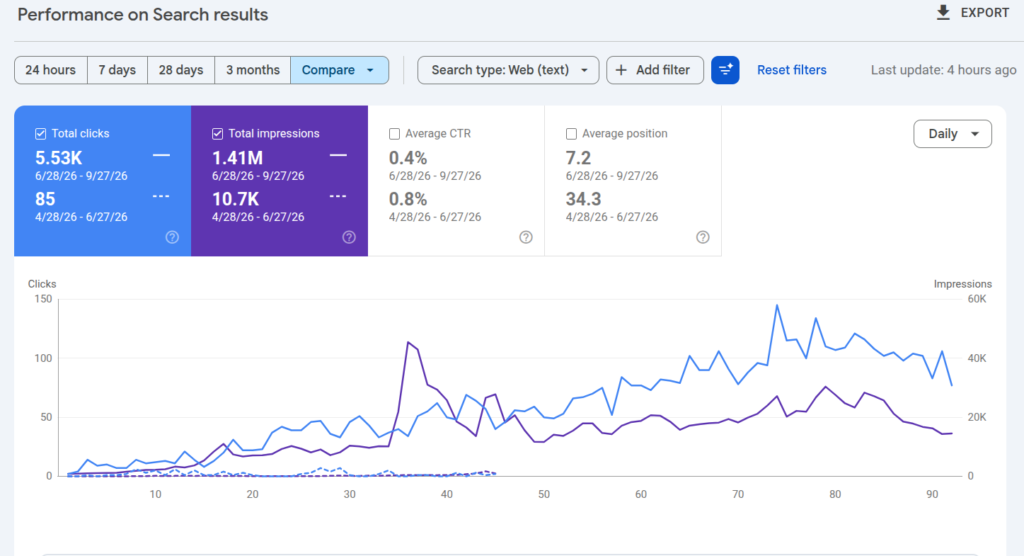
Image caption: Google Search Console comparison showing clicks, impressions, average CTR, and average position across the two reporting periods.
Visibility in Google’s Generative AI Features
The second screenshot shows data from Google Search Console’s Generative AI features report.
| Metric | April 28–June 27, 2026 | June 28–September 27, 2026 |
|---|---|---|
| Total impressions | 1,110 | 563,000 |
The later period recorded 563,000 impressions, compared with 1,110 in the earlier period.
This is a substantial change in the impressions reported for that feature category. It is worth examining alongside the website’s broader search performance because search visibility can extend beyond traditional blue-link results.
However, these figures should be interpreted according to what the report actually measures. They do not represent 563,000 website visits, and they do not establish that digital PR or link building directly caused the increase.
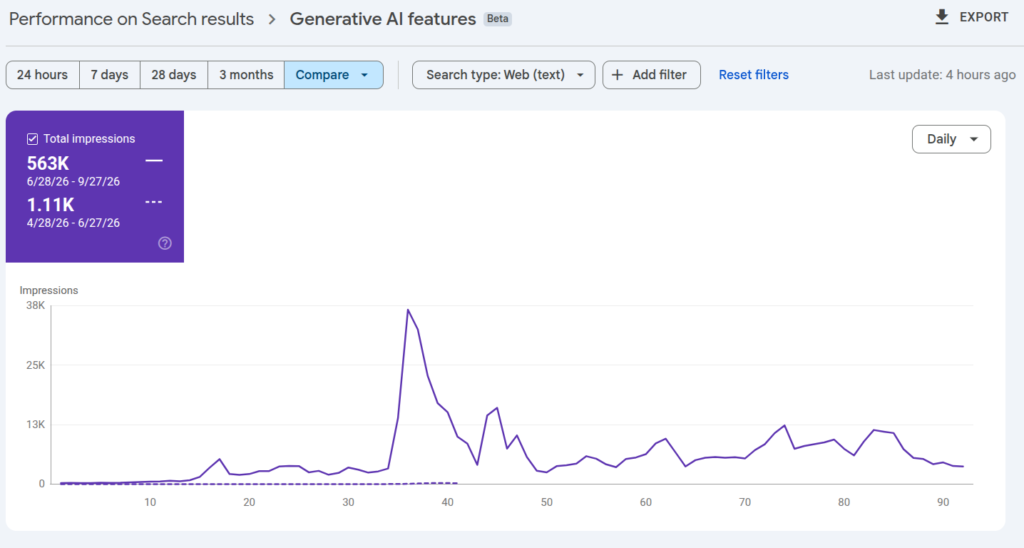
Image caption: Google Search Console Generative AI features report comparing impressions across the selected periods.
What These Results Mean for SaaS Link Building
The data illustrates why it is useful to look beyond a backlink count when evaluating SEO performance.
A campaign report can show outreach activity, potential placements, and published links. Google Search Console can show how a website performs in search. Together, these sources can provide a more useful picture than either one alone, provided their limitations are understood.
The Search Console screenshots show that the website recorded considerably more impressions and clicks during the later period. They also show a stronger average position and a substantial increase in impressions reported for Google’s Generative AI features.
What the screenshots do not show is which individual backlinks were indexed, which pages benefited from them, or how much of the search growth can be attributed to the campaign.
Establishing that connection would require a more detailed review of verified published URLs, acquisition dates, target pages, query performance, and other SEO changes made during the same period.
This distinction matters. A credible case study should demonstrate the results that can be verified without turning a correlation into a claim of causation.
Lessons From the Campaign
There are several practical lessons for SaaS businesses and SEO teams considering digital PR and link building.
First, use more than one acquisition method when it fits the campaign. Publisher outreach, guest posts, niche edits, and digital PR provide different routes to relevant coverage and links.
Second, assess the context of a placement rather than relying on a third-party metric alone. A link should fit the topic, the publication, and the destination page.
Third, keep outreach records separate from confirmed placements. A conversation is an opportunity, not a completed link. Published URLs should be checked and recorded before campaign totals are reported.
Finally, evaluate link acquisition alongside search performance. Search Console data can help identify changes in visibility, while campaign records can help establish what work was completed. Combining the two makes it easier to ask better questions about performance.
Final Thoughts
This project combined publisher outreach, guest-post opportunities, link insertions, and digital PR outreach to support a SaaS startup’s link-acquisition efforts.
During the later reporting period, Google Search Console recorded 1.41 million search impressions and 5,530 clicks. The reported average position was 7.2, and the Generative AI features report recorded 563,000 impressions.
Those figures make the website’s search performance worth a closer look. However, they should not be treated as proof that link building alone drove the growth.
For SaaS companies, the practical takeaway is to approach link acquisition with a focus on relevance, sound outreach, editorial context, and accurate reporting. When campaign records and search performance data are evaluated together, they provide a stronger basis for understanding what is happening and deciding what to do next.
Looking for digital PR and link-building support for your SaaS business?
I work with businesses and SEO teams on publisher outreach, guest posts, link insertions, and link-acquisition campaigns. If you’re looking to build relevant publishing opportunities for your website, get in touch to discuss your goals.
Reporting source: Google Search Console screenshots supplied for this case study. Reporting periods: April 28–June 27, 2026, and June 28–September 27, 2026.